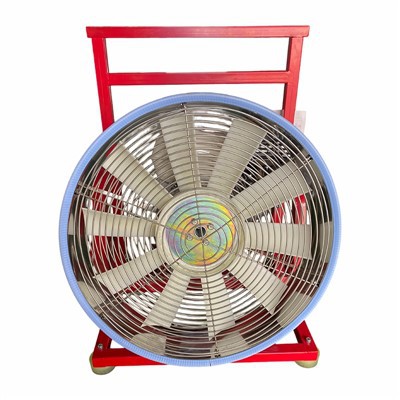
As a supplier of fire rated exhaust fans, I often encounter customers who have questions about adjusting the speed of these essential devices. Fire rated exhaust fans play a crucial role in maintaining air quality and safety in various settings, especially during a fire emergency. Adjusting the speed of these fans can optimize their performance according to different needs. In this blog, I will share some insights on how to adjust the speed of a fire rated exhaust fan. Fire Rated Exhaust Fan
Understanding the Basics of Fire Rated Exhaust Fans
Before delving into the speed adjustment process, it’s important to understand the basic functions and components of a fire rated exhaust fan. These fans are designed to operate under extreme conditions, including high temperatures, for a specified period. They are typically used in buildings to remove smoke and hot gases during a fire, facilitating the safe evacuation of occupants and minimizing property damage.
A fire rated exhaust fan consists of several key components, such as the motor, blades, housing, and control system. The motor is the power source that drives the blades to rotate, creating airflow. The control system is responsible for regulating the fan’s operation, including its speed.
Reasons for Adjusting the Fan Speed
There are several reasons why you might need to adjust the speed of a fire rated exhaust fan:
- Energy Efficiency: Running the fan at a lower speed when full capacity is not required can reduce energy consumption and lower operating costs.
- Noise Reduction: High – speed operation can generate significant noise. Adjusting the fan speed to a lower level can create a more comfortable environment.
- Adapt to Different Conditions: In normal ventilation scenarios, a lower speed may be sufficient. However, during a fire emergency, the fan needs to operate at its maximum speed to effectively remove smoke and gases.
- System Balance: In a complex ventilation system, adjusting the fan speed can help balance the airflow between different areas.
Methods of Adjusting the Speed of a Fire Rated Exhaust Fan
1. Motor – Based Speed Control
- Variable Frequency Drives (VFDs)
This is one of the most common and effective methods for adjusting the speed of a fire rated exhaust fan. A VFD is an electronic device that controls the frequency and voltage supplied to the motor. By changing the frequency, the VFD can vary the motor’s speed.
The advantage of using a VFD is its high level of control. It allows for precise speed adjustment over a wide range, and it can also provide soft – starting and soft – stopping functions, which reduce mechanical stress on the motor and the fan blades. However, VFDs can be relatively expensive, and they require proper installation and programming.
To adjust the fan speed using a VFD, you first need to access the VFD’s control panel. This can usually be done on – site or remotely, depending on the configuration. Once you have access, you can use the control panel’s interface to set the desired frequency, which will correspond to a specific fan speed. - Multi – Speed Motors
Some fire rated exhaust fans are equipped with multi – speed motors. These motors have multiple windings that can be switched to operate at different speeds. For example, a two – speed motor can typically operate at a high speed and a low speed.
Adjusting the speed of a multi – speed motor is relatively straightforward. It usually involves using a switch or a contactor to change the electrical connection to the motor windings. However, the number of available speeds is limited, and the transitions between speeds may not be as smooth as those achieved with a VFD.
2. Damper – Based Speed Control
- Inlet or Outlet Dampers
Dampers are devices that can be used to control the airflow through the fan. By adjusting the position of an inlet or outlet damper, you can restrict or increase the amount of air entering or leaving the fan, which in turn affects the fan’s speed.
If you close the damper partially, the resistance to the airflow increases, and the fan will slow down. Conversely, opening the damper fully allows for maximum airflow, and the fan will operate at its highest speed.
However, this method has some limitations. Closing the dampers too much can cause the fan to operate inefficiently, and it may also generate additional noise. Additionally, dampers are more suitable for making rough adjustments to the airflow, rather than precise speed control.
Considerations When Adjusting the Speed
- Safety Regulations: When adjusting the speed of a fire rated exhaust fan, it’s crucial to comply with all relevant safety regulations. These regulations are in place to ensure that the fan will function properly during a fire emergency. For example, some regulations may specify the minimum and maximum speeds at which the fan can operate.
- System Compatibility: Make sure that any speed – adjustment method you choose is compatible with the overall ventilation system. For example, if you are using a VFD, ensure that it is compatible with the motor and the control system of the fan.
- Performance Monitoring: After adjusting the fan speed, it’s important to monitor the fan’s performance. This includes checking the airflow rate, the pressure, and the power consumption. You can use instruments such as anemometers and pressure gauges to measure these parameters.
Troubleshooting Common Issues
- Inconsistent Speed: If the fan’s speed is inconsistent, it could be due to a problem with the control system. Check the wiring connections, the control panel settings, and the functionality of the VFD or other speed – control devices.
- Excessive Noise: Excessive noise during speed adjustment may indicate a mechanical issue, such as unbalanced blades or loose components. Inspect the fan blades for any signs of damage or imbalance, and tighten any loose bolts or screws.
- Poor Airflow: If the airflow is not as expected after speed adjustment, it may be due to a blocked damper or a problem with the fan’s intake or exhaust. Check the dampers and ensure that there are no obstructions in the ventilation ducts.
Importance of Professional Installation and Maintenance
Adjusting the speed of a fire rated exhaust fan is a technical task that requires a certain level of expertise. It’s highly recommended to have the installation and adjustment of the fan and its speed – control devices performed by a professional. Professionals have the knowledge and experience to ensure that the fan is installed correctly, that the speed – adjustment method is appropriate, and that all safety regulations are complied with.
Regular maintenance is also essential for the proper functioning of the fire rated exhaust fan and its speed – control system. This includes checking the motor, the blades, the control system, and the dampers for any signs of wear or damage. Scheduled maintenance can help prevent potential problems and ensure that the fan is always in good working condition.
Contact for Procurement and Consultation

If you are interested in purchasing fire rated exhaust fans or need more information on how to adjust their speed, feel free to contact us. Our team of experts is ready to provide you with professional advice and high – quality products. We can offer a range of fire rated exhaust fans with different specifications and speed – control options to meet your specific needs. Whether you are a building manager, an engineer, or a contractor, we are here to assist you in ensuring the safety and efficiency of your ventilation systems.
References
Fire Ladder ASHRAE Handbook – HVAC Systems and Equipment.
NFPA 90A: Standard for the Installation of Air – Conditioning and Ventilating Systems.
Manufacturer’s installation and operation manuals for fire rated exhaust fans.
Taizhou Mingxin Fire Protection Technology Co., Ltd.
As one of the most professional fire rated exhaust fan manufacturers in China, we warmly welcome you to buy bulk high quality fire rated exhaust fan made in China here from our factory. Good service and low price are available.
Address: Group 3, Xinzhouqiao Community, Jingtai Road Subdistrict, Hailing District, Taizhou City (within Taizhou Station North Logistics Management Co., Ltd.)
E-mail: mingxinxf@163.com
WebSite: https://www.mxfiretech.com/
