If you’ve ever stood on a manufacturing floor watching a robotic arm snap into place to fasten a car door, a medical device align a tiny implant with millimetric precision, or a packaging line zip a box shut with unerring speed, you’ve likely relied on a servo motor to make that motion happen. As a servo motor supplier, I get asked dozens of questions every week, but none is as common—or as layered—as, “What’s the maximum speed of a servo motor?” The answer isn’t a single number you can glance up in a spec sheet; it’s a conversation shaped by design, application, load, and the fine line between technical performance and real-world usefulness. Today, I’m breaking down that conversation, using decades of working with engineers, machine builders, and small business owners who depend on servo motors to keep their operations running. Servo Motor
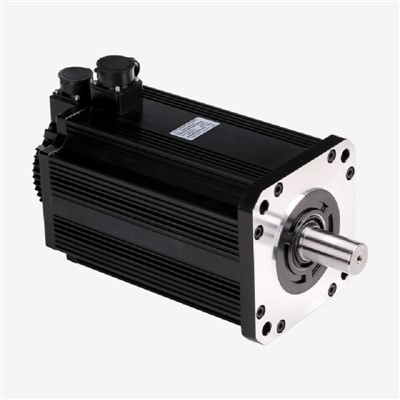
First, let’s start with what a servo motor actually is, because that foundation is key to understanding its speed. Unlike a standard AC induction motor, which just spins at a fixed speed based on its power supply, a servo motor is a closed-loop system. That means it’s paired with an encoder (a sensor that tracks position and speed) and a controller that sends constant corrections to the motor to hit exactly the target position, speed, or torque you set. No slip, no unexpected drift—just precise, controlled motion, even when loads change. That closed-loop design is both the superpower and the speed limiter of servo motors.
Now, when someone asks for the maximum speed, most immediately think of the motor’s unloaded no-load speed. This is the speed the motor reaches when there’s zero load on its shaft, no friction, no resistance, just the motor spinning as fast as it can when powered to its maximum voltage. For most industrial servo motors, that number falls between 3,000 RPM and 8,000 RPM. But here’s the first important caveat: no-load speed is almost never the speed you’ll actually use in a real application. In the real world, every motor has a load—whether it’s a robotic arm holding a weld gun, a conveyor belt carrying 50-pound boxes, or a printer head moving across a sheet of paper. When you add load, speed drops. Torque and speed have an inverse relationship in servo motors: higher speed means lower available torque, and higher torque means lower speed. The only time you get maximum torque is at 0 RPM (when the motor is holding a position, like a door waiting to be closed), and the only time you get maximum speed is with zero torque. That’s a tradeoff every engineer learns to balance.
To get a clearer picture of how this plays out, let’s look at a common example: a 1 kW mid-range industrial servo motor, the kind we supply to small and medium manufacturers for packaging and material handling. Its no-load speed might be 6,000 RPM. But if you use it to power a conveyor belt that needs to move 100-pound crates, the torque required to move that load will drop its operating speed to around 2,000–3,000 RPM. If you’re using it for a lightweight application, like a pick-and-place robot moving 2-gram electronic components, you might be able to run it at 5,000 RPM or even close to the no-load peak speed, because the load is minimal.
But wait—what about ultra-high speed servo motors? For applications that need faster motion than standard servos can provide, there are high-speed servo motors designed specifically for that. These are usually built with more efficient winding designs, lighter rotors, and bearings that can handle the heat and friction of constant high-RPM operation. For example, some high-speed servos for applications like laser cutting or high-speed labeling can reach no-load speeds of up to 15,000 RPM. That might sound impressive, but again, you can’t use that full speed under load. A 15,000 RPM high-speed servo might only hit 10,000 RPM when carrying a small cutting head, and only 5,000 RPM if it’s handling any meaningful torque.
There’s another factor that most people overlook when talking about servo speed: the application’s own requirements. Let’s take a medical device example, like a surgical robot that aligns a tool for a procedure. Even if a servo can spin at 12,000 RPM, it can’t operate at that speed here. The medical team needs precision, not speed—they need the tool to move at a controlled 500 RPM to avoid damaging tissue, because the risk of error at high speed is too great. On the flip side, a pick-and-place machine moving components for smartphones needs speed, but not just speed—it needs to accelerate from 0 to its operating speed in milliseconds to keep up with production lines moving 100 parts per minute. That acceleration, not just top speed, is often the more critical performance metric. A motor that can reach 5,000 RPM in 10 milliseconds is more valuable here than a motor that can hit 7,000 RPM in 20 milliseconds, even if the top speed is lower.
Now, I know some of you might be thinking: “What about continuous vs. peak speed?” That’s another distinction that causes a lot of confusion. Continuous speed is the speed a servo can run at for hours on end without overheating, wearing out prematurely, or failing. Peak speed is the short-term maximum speed the motor can handle, usually for bursts of less than a minute. For example, a motor’s continuous speed might be 4,000 RPM, while its peak speed is 7,000 RPM. Running at peak speed for too long will cause the motor’s windings to overheat, which will reduce its lifespan and could lead to a breakdown on the production line. As a servo motor supplier, I always advise customers to size their motors for continuous operating speed, not just peak speed. It’s easy to get excited about a high peak RPM, but if your application needs to run 24/7, that continuous number is what matters.
There are also external factors that limit how fast a servo motor can go, even if its specs say it can hit 10,000 RPM. First, the gearbox. Most servo motors are paired with gearboxes to reduce speed and increase torque for applications that need more power at lower speeds. Gearboxes multiply torque by dividing speed, so if you pair a 6,000 RPM motor with a 5:1 gear ratio, your output speed drops to 1,200 RPM, even if the motor could spin faster. If you really need high output speed, you’ll use a lower gear ratio, or no gearbox at all—but that means you’ll have less torque to handle loads. Second, the controller and feedback system. The encoder that tracks position and speed has a maximum data rate. If the motor is spinning so fast that the encoder can’t send position data to the controller quickly enough, the controller can’t make the small adjustments needed to keep the motion precise, and you’ll get erratic movement, or even a safety shutoff. Third, mechanical components: belts, shafts, and bearings all have their own speed limits. A belt that works fine at 3,000 RPM will start to vibrate and fail at 8,000 RPM, because centrifugal force puts too much stress on the material. That’s why it’s not just the motor’s speed that matters—it’s the entire system.
I want to share a real example from a customer we worked with last year to make this concrete. A small automotive parts manufacturer came to us with a problem. They had a robotic arm that used a standard servo motor to place door hinges on car frames, but production was too slow. Their old motor was a 3,000 RPM servo that could only run at 1,800 RPM when handling the 15-pound hinge, so each cycle took 2 seconds. They asked if we could sell them a motor that could spin at 10,000 RPM to cut cycle time in half. At first, that seemed like a simple upgrade—but when we looked at their application, we realized it wasn’t. The robotic arm’s joints, belts, and the precision required to align the hinge within 0.1mm meant they couldn’t run any faster than 2,500 RPM, even if the motor could hit 10,000 RPM. We recommended a mid-range servo motor with a higher torque-to-speed ratio, built to run consistently at 2,500 RPM under load, and it cut their cycle time by 30% without straining their existing mechanical system. That’s the thing about servo speed: it’s not about how fast the motor can go—it’s about how fast it can go while still doing its job correctly.
Now, for the engineers reading this (I see you, with your spec sheets and load calculators), there are a few technical terms you’ll want to know to nail down the exact maximum speed for your application. Base speed is the speed at which the motor reaches its rated voltage, and it’s tied to the motor’s pole count. Motors with fewer poles spin faster; more poles spin slower but have higher torque at low speeds. For example, a 2-pole servo motor has a higher base speed than an 8-pole motor, all else being equal. Another term is maximum allowable speed (MAS), which is the highest speed the motor can operate at without permanent damage. MAS is listed in every good servo spec sheet, and it’s non-negotiable—operating above MAS will void warranties and cause catastrophic failure, because it puts too much stress on the rotor, bearings, and windings.
I’ve seen customers make two common mistakes when choosing servo motors for speed. First, they chase the highest number on the spec sheet, ignoring their load and application needs. They buy a motor with a 10,000 RPM no-load speed, only to find they can’t run it faster than 2,000 RPM because their gearbox and mechanical parts can’t handle higher speeds. Second, they forget about heat. High-speed motors generate more heat, and if your application is operating in a hot environment (like a metal stamping plant that’s 100°F inside), that extra heat will reduce the motor’s effective speed and lifespan. We always recommend checking the motor’s thermal rating, especially for high-speed applications.
So, to wrap up this question: what is the maximum speed of a servo motor? There’s no single answer, because it depends on who is asking, what they’re using the motor for, and what their system can handle. But to give you a general framework:
- Standard industrial servo motors: No-load speed 3,000–6,000 RPM, continuous operating speed under load 1,000–4,000 RPM.
- High-speed servo motors: No-load speed up to 15,000 RPM, continuous operating speed under load up to 10,000 RPM.
- Maximum allowable speed (the hard limit before damage) varies by manufacturer and model, but most fall between 10,000–20,000 RPM for industrial servos.
That said, I’d be remiss if I didn’t emphasize: speed is only one piece of the puzzle. A servo motor is a system, not a standalone part. Torque, precision, acceleration, thermal performance, and durability matter just as much, if not more, than top speed. If you’re building a machine, you need a motor that fits your application, not the other way around.
If you’re in the market for a new servo motor, or you’re looking to upgrade an existing system to get better speed without sacrificing precision or reliability, I’d love to talk through your needs with you. As a servo motor supplier, I’ve worked with everything from small custom machine shops to large Fortune 500 manufacturers, and I know that one size never fits all. We can walk through your load requirements, mechanical constraints, production goals, and help you find the right motor that will perform when you need it, without the risk of overspending on unnecessary speed or underperforming when you need power. Reach out to our team to discuss your project and get tailored guidance for your application.
Permanent Magnet DC Moto References
- Bolton, W. (2015). Electrical Machines and Drives (3rd ed.). Pearson Education Limited.
- Krishnan, R. (2001). Permanent Magnet Synchronous and Brushless DC Motor Drives. CRC Press.
- Motion Control Association. (2022). Servo Motor Application Guidelines and Performance Specifications.
- Bose, B. K. (2002). Modern Power Electronics and AC Drives. Prentice Hall.
- American National Standards Institute. (2019). Standard for Rotating Electrical Machinery: Servo Motor Performance and Testing Methods.
Zibo Auric Mechanical and Electrical Technology Co., Ltd.
As one of the leading servo motor manufacturers and suppliers in China, we warmly welcome you to buy advanced servo motor for sale here from our factory. All customized motors are with high quality and competitive price.
Address: B419, High-tech Entrepreneurship Park, High-tech Zone, Zibo City
E-mail: cui@auricmotor.com
WebSite: https://www.auricmotor.com/
